Monkey Realism and Wet Meat Robots
Sam Harris and Daniel Dennett disagree about free will, and most of the disagreement rests on determinism being a thing. A materialist argument for why quantum indeterminacy plus chaos means it isn’t.
In the search for a clear understanding of consciousness, there is a schism amongst many in how we interpret the notion of free will in accordance with the commonly accepted materialist notion that “we are our physical brains and neurological system”. If you believe in disembodied souls, magic energy, or that our selves have a dual existence apart from our brains, then this post might not be for you. Such beliefs eschew science in favor of religion as a starting position. But if you are open to digging deeper, and are interested in arguments for why dualism is hokum, you can read this, and this, then come back to this essay.
Still with me? Great.
So the dominance of the materialist view of consciousness doesn’t mean that everyone is on the same page. Quite the opposite in fact. There are wide divergences in the interpretation of what consciousness as a material phenomena actually implies. And much of this disagreement is concentrated around whether or not we have “free will”. The topic of free will is like a conceptual singularity that vacuums up all the brain juice exerted by modern philosophers and prevents further productive discussion.
Sam Harris and Daniel Dennett are two of the more prominent figures these days in the realm of theories of mind and consciousness, and feature prominently in the free will schism. They recently traded blows (essays actually), with Dan making a critical review of Sam’s recent book, “Free Will”, and Sam rebutting Dan’s review in an essay on his blog.
So you don’t have to spend the next month reading all the literature they have composed over the years (Though I recommend you do anyways at some point. It’s worth it.), I’ll summarize their positions:
Sam is a materialist and strict determinist. He says that determinism leaves no room for free will (or anything at all one could call free will), and claims that indeterminism (if it exists) is irrelevant to the discussion by saying that his philosophy of mind “includes the contributions of indeterminism as well”.
Dan is a materialist who, rather than take a stance on determinism, has derived an interpretation of free will that he claims is compatible with both determinism and indeterminism. He says determinism just doesn’t matter, and that we have free will, or at least something you can call free will, that is good enough relative to what regular people consider free will. Sam thinks this is a copout.
Apologies if my TLDR omitted any important nuances! They have a lot more to say on the topic that I left out, but I included the salient bits (IMO) that are relevant to the schism.
You might notice I mention determinism prominently in my summary of their views. And I did it for a reason. Sam roots much of his philosophy of mind on determinism being a thing. That our pasts couldn’t have happened any other way, and that our futures are written in stone. This underpins a lot of the disagreement between him and Dan, who otherwise, would have nearly identical models of the mind.
If we want to bring a bit of resolution all this, it seems like we have an obvious place to start.
The Golfer Named Austin#
Sam central rebuttal to Dan’s critique focuses on a thought experiment first put forth by Dan about a golfer named “Austin”, who misses a putt slightly and exclaims that he “could have made it!”. Sam says:
“Let’s make sure you and I are standing on the same green: We agree that a human being, whatever his talents, training, and aspirations, will think, intend, and behave exactly as he does given the totality of conditions in the moment. That is, whatever his ability as a golfer, Austin would miss that same putt a trillion times in a row—provided that every atom and charge in the universe was exactly as it had been the first time he missed it. You think this fact (we can call it determinism, as you do, but it includes the contributions of indeterminism as well, provided they remain the same) says nothing about free will. You think the fact that Austin could make nearly identical putts in other moments—with his brain in a slightly different state, the green a touch slower, and so forth—is all that matters.”
and
“…Next time he might try harder. But this time—with the universe and his brain exactly as they were—he couldn’t have tried in any other way.”
I’m not sure Sam and Dan are standing on the same green.
The physics of reality is a lot weirder than Sam is giving credit. Let’s examine what Sam means by “the universe and his brain exactly as they were”. The location, position and velocity of things are totally dependent on your frame of reference[1][2]. Heck, even the ordering of events depends on your frame of reference. Events we would call simultaneous might seem to be non-simultaneous from the perspective of electrons darting around your brain, or photons shooting into your eye[1]. And what time ‘T’ do we pick? It isn’t even clear when one marks the beginning of the causal chain of events leading to the putt. Sam might say that this causal chain goes back to the big bang. But let’s ignore all that for the time being and give Sam the benefit of the doubt and say he has a fixed frame of reference for some chosen time ‘T’, ‘S’ seconds before the putt happens. What does Sam really mean at that instant where his thought experiment takes this “snapshot” of the universe’s “configuration”? The reality of it means something different than I think Sam intended. The truth is there isn’t a single configuration so much as a series of probabilities that depend on measurements. To talk about a single configuration of every particle, charge, and field in the universe betrays a misunderstanding of how the universe works. Though probably very much dominated by the “observable configuration” of all the matter, forces and energy in his body, brain and the universe, the outcomes of the next time step aren’t entirely determined. If QM is correct, there is a non-zero probability that if you could rewind time without changing anything, given infinite retries, one of the putts would go in, with the divergence of possible outcomes increasing the further back you rewound time ‘T’. In fact, the many worlds interpretation of QM implies that in some reality, it DID go in. But you don’t have to ascribe to the many worlds interpretation to follow the rest of the argument :).
I know the mention of Quantum Mechanics in the context of free will and consciousness is often mixed with a bunch of pseudo-scientific mumbo jumbo. And that by bringing it into the conversation I am no doubt stimulating a bunch of intellectual immune responses that make you want to stop reading. But please bear with me :).
Small Becomes Big#
QM deals with probabilities, and implies true non-determinism at the very small scale. Weird things happen. Particles pop in and out of existence and vanish and reappear in different locations. They sometimes “interact” across unrelated events in time (like in the double slit experiment), or entangle with other particles across vast distances of space.
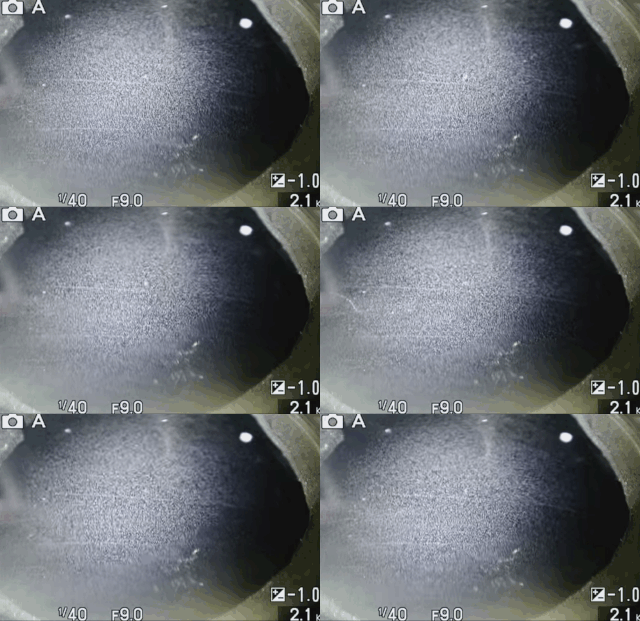
We know that Quantum fluctuations can have macroscopic effects [4][5][6]. In the gif above, if we pay attention to the left side of the frame, we can see vapour jets arise from “seeds” laid by collisions with charged particles (muons) in a pint glass [5]. Quantumly random phenomena, that magnify to the scale of something we can see with the naked eye! There are more examples of macroscopic quantum phenomena. We can measure Casimir forces due to virtual particles birthed from nothing exerting a pressure differential on plates with small gaps between them [6]. And see the remnants of magnified quantum fluctuations in the cosmic background radiation [4].
Now, I would never argue that any single quantum fluctuation has a causal macroscopic effect on our choices. Decoherence happens quickly, and there isn’t any evidence that a tiny minute shift in any one single electron for example will have a macroscopic effect on neural activity. But that isn’t the point I’m trying to make. To understand the point I’m trying to make, we first must briefly get an intuition for Chaos.
Chaos simply refers to systems with extreme sensitivity to initial conditions. So much so that the future states of such a system, even deterministic ones, are so wildly divergent, that you can never be precise enough with your initial inputs to predict the end result after a certain number of steps through the system. Let me be clear by what this means. It’s very likely that the general thrust and biases of our decisions and actions are very much dominated by our macroscopic brain structure and the current measurable chemical and electric activations. But… there are things that seem to sit on the razor’s edge. The timing of micro muscle movements. The choice between two seemingly equally probably options A and B. That all could be affected by subtly different initial conditions. And I argue that there is a lot of evidence that they are. Chaos provides a mechanism for lots of small fluctuations to have big effects.
It’s the reason why you would want to be up in front of a judge just after lunch rather than later in the afternoon [3]. Or why holding a cold cup of water on a rainy day might make you slightly less likely to be nice to person on the phone calling to sell you insurance you don’t want. Small changes can affect our conscious choices, and the divergence in possible outcomes only gets larger the further we step into the future.
Wet Meat Robots#
Our brains are one of most (if not the most) complicated physical structures we know about in existence. And the brain is not just a bunch of wires connected in some static configuration. Many people in the determinist camp have this intuition that our brains are some sort of crystalized entity, with our neural pathways etched into spongy strata. In reality, our brains are much more than wires. They are each a chemical soup of quantum interactions. Neurotransmission is indeterministic chemistry. It’s not like switching on a lightbulb.
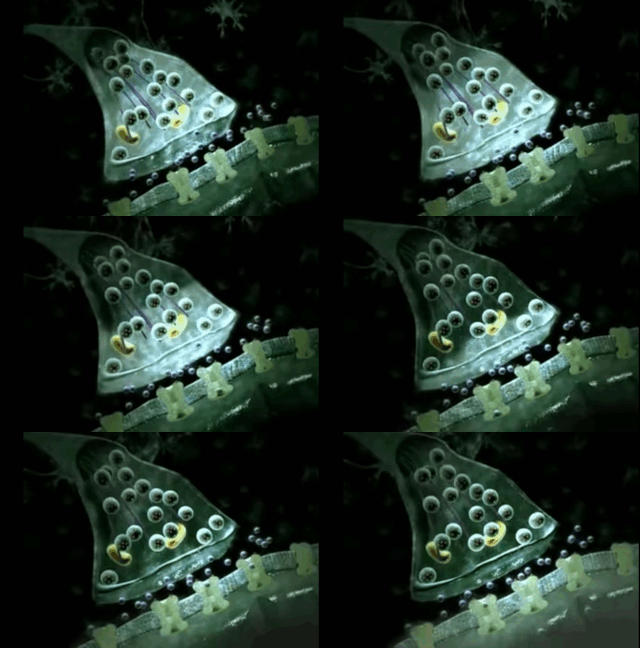
Depression, mania, our moods and our creativity, all emerge from our wet soupy frothy innards. Neurotransmitters ebbing and flowing, electrons storming, and all the weirdness of the chemistry and physics of the small, summing up to manifest who we are.
Even simple idealized 3 body systems possess chaotic dynamics. The physics of our brains (which is the physics of reality) almost certainly possesses chaotic dynamics. Seas of quantum fluctuations, can and do manifest in different macroscopic outcomes. Our brain’s aren’t special in this regard. It would mean a monumental shift of our understanding of the way the world works to say that our brains aren’t influenced by quantum mechanics, or to claim that every micro muscle movements, thought, or action was predetermined via a strict causal chain connected to the moment of the big bang.
The universe is much weirder than these simple thought experiments ever account for. And since we don’t possess the ability to travel in time without side effects, or snapshot universe probability configurations, we can’t directly test these hypotheses. But, we can test that quantum fluctuations exist (they do). And although exceedingly difficult (because of the problem of measuring conscious affect) we can study the effects of small changes to the brain.
Lines In The Sand#
We are evolved to think about things on the scale of a banana [5]. The implications of this are that we are “setup” to think about cause and effect as immutable truths of this existence. We have a sense of realism useful to us (and also to monkeys) that tell us B happened because of A. But it is this intuition that everything must follow a causal chain that runs smack against the reality that quantum mechanics says otherwise for the very small. And it is this incompatibility that leads many brilliant minds astray.
Sam Harris attempts to shrug off the effects of indeterminism using two points that I paraphrase below:
- “Things are either deterministic, or purely random. And things that are random can’t be attributed to us anyways. Thus no free will.”
and
- “The chain of causation includes the contributions of indeterminism, if there were any. Randomness happens, then things bubble up to a deterministic realm, and we still don’t have free will because “the parts that matter” follow a chain of causation.”
Let’s start with the first one.
Claim #1 Deterministic or Purely Random
The statement that things are either deterministic or purely random is flat out wrong. To quote Scott Aaronson:
“For me, the glaring fallacy in the argument lies in the implication Not Determined ⇒ Random. If that was correct, then we couldn’t have complexity classes like NP—we could only have BPP. The word “random” means something specific: it means you have a probability distribution over the possible choices. In computer science, we’re able to talk perfectly coherently about things that are non-deterministic, but not random.”
You can have algorithms that don’t know what their inputs will be. That is a form of indeterminism that is not random!
More subtly though, this first point that Sam makes is really Dualism subtly creeping its way back into the conversation. To say that “things that are random cannot be attributed to us” implies that there is some “us” separate and apart from the physical reality of the brain. But we materialists agree that there isn’t! It’s perfectly consistent to take the physical brain, and the indeterministic components as an implementation detail of “us”. Not a separate thing. It IS us.
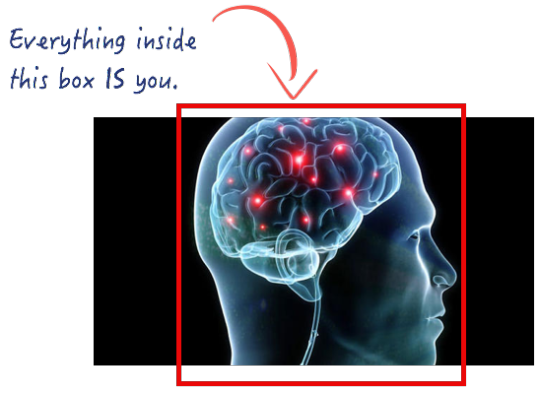
Our consciousness arises out of unconscious bits and bobs. Though the details of that are still being worked out, this IS the materialist view that Sam claims to ascribe to. The notion that we cannot accept “responsibility for our choices” because “there is only matter and energy interacting” is tantamount to saying that it’s because there is no “disembodied magic soul self”. It’s a silly and circular way to set things up since (without the arguer realizing it) it makes the assumption first that a real self can’t arise from a physical system, to then assert that we can’t have free will because the physical system was responsible for generating the thoughts. It is arbitrary consciousness gerrymandering that doesn’t really add much to the conversation.
Claim #2 The chain of causation includes the effects of indeterminism.
Essentially, what Sam tries to say here is that randomness happens, then things bubble up to a deterministic realm, where we have chain of causation, and we still don’t have free will because “the parts that matter” follow determinism. This argument amounts to drawing a line in the sand where free will still falls on the side of a determined causal chain, thus rendering it “not free”.
Thought experiment time.
Someone chooses to fire a bullet at a target. Surely once the bullet has left the barrel “we” don’t have control over where it ends up anymore. The flight path is subject purely to the laws of ballistics. So that can’t be the right place to draw the line. But how far back do we have to go?
Hopefully by now we have established that the chain of causation can be broken (at least in parts) by true randomness at the quantum level, and that things are not predetermined from time immemorial. Where does one draw the line in the sand demarking when an action “came from us” or not?
Sam puts a lot of weight on the belief that conscious realisation of one’s actions is a clear demarcation of the beginning of choice. And there are many experiments that show that this happens long after the cascade of neural activity leading to the action has been initiated [8]. But the concept that “choice happens simultaneously when you perceive that it does” is an arbitrary one, and it genuinely makes no sense given that “you” are also the unconscious processes that underpin the causal chain of neural activity that lead to the pulling of the trigger. To claim that you aren’t implies that there is a separate you hiding in your brain that makes the realization that you didn’t choose to do it! If you accept that dualism is wrong, then it should not matter that conscious actions are initiated before you are able to report that they got initiated. Those processes arise from the non-deterministic machinery of “you” that include both components for which you can establish a causal chain, as well as components that possess quantum indeterminacy. It’s all about where you draw the “you” box.
Wrap it up#
In case it isn’t clear, I believe that determinism is incompatible with the accepted interpretation of Quantum Mechanics on a very fundamental level. And I think there is sufficient evidence for most people to agree with me. Does this mean we have free will? Not directly, but I’ve hopefully eviscerated any arguments that use determinism as proof that there is no free will. And if you define the “I” in a way that avoids dualism (the brain and all it’s unconscious operations, as well as the conscious acknowledgements, are how “you” are implemented), then you are free (hehe) to say truthfully that you are the one making the choices. That’s good enough for me.
Read follow up post, I choose to believe in free will.
References#
- “The pole and barn paradox”
- “The twin paradox”
- “Thinking Fast And Slow” by Daniel Kahneman
- Quantum fluctuations causing temperature variations in the CMB
- Quantum theory: it’s unreal.
Note: The above is the Inaugural lecture of Professor Terry Rudolph, where I aped (har har) the term “monkey realism” and “evolved to think about things at the scale of a banana”. It’s a good lecture. Go watch it! - Casimir Effect
- Chaos Theory
- Predicting Abstract Intentions
Note: Interested readers can read up on experiments showing lead times of activity in the brain that precede conscious choices.